CoMove

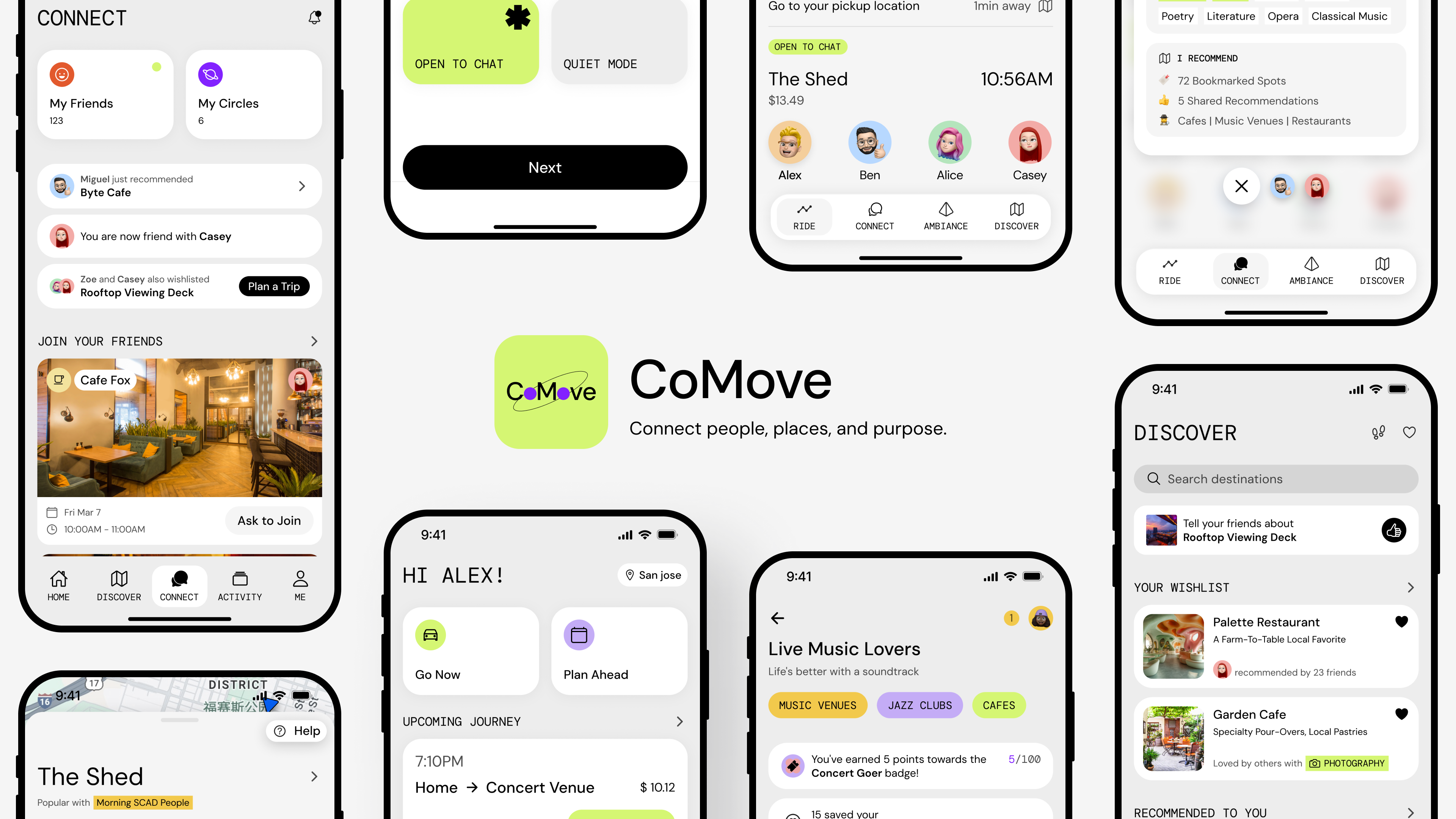
CoMove redefines ride-sharing for Gen Z by integrating AI-driven social matching to transform shared mobility into a platform for organic, interest-based interactions.

For

MFA Thesis

Time

Jan - Mar 2025

Role

Brand Design / UI design / UX design / UX Research

Type

Speculative / Mobility / Social / Mobile

The problem isn’t transit. It’s social comfort.

Mobility as a missed

social opportunity

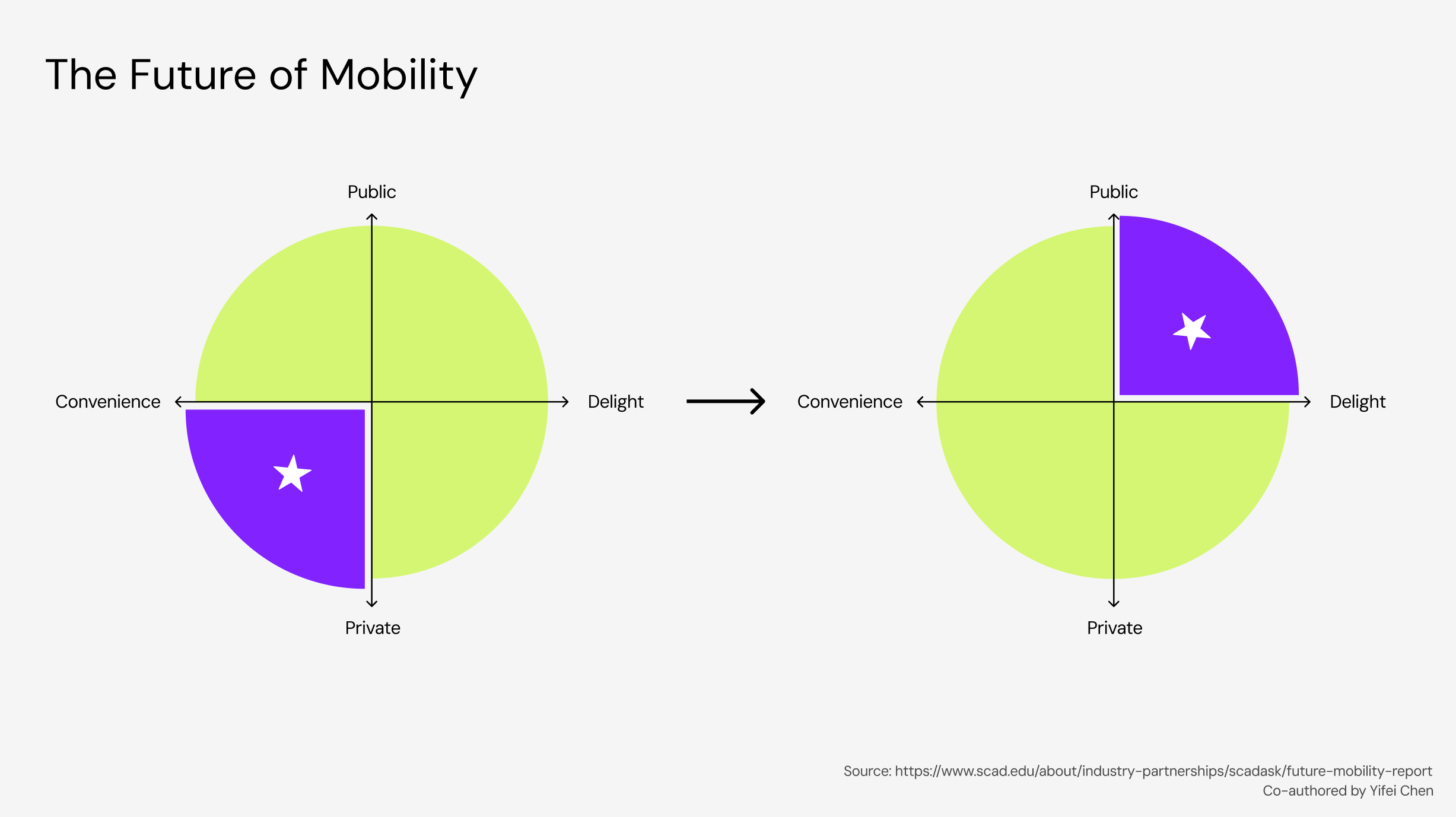
Gen Z’s relationship with transportation is shifting in ways that traditional mobility products haven’t fully caught up with. They’re driving less, more sustainability-minded, and economically cautious, which makes shared mobility and public transit more relevant than ever. At the same time, they’re also seeking meaningful in-person connection, even as digital natives.


But today’s options often force a tradeoff:

  • Public transit can feel unsafe, uncomfortable, or socially awkward
  • Private vehicles offer comfort and control, but are expensive and increasingly misaligned with Gen Z priorities
  • Ride-sharing solves logistics, but rarely designs for the social experience of sharing space


This creates a gap: shared mobility is practical, but it doesn’t always feel socially or emotionally hospitable.


So CoMove reframes the question from “how do we move people efficiently?” to:


How might we bridge affordable shared mobility with the comfort and agency of private vehicles—by turning shared transit into an opportunity for organic connections?
Research into a design direction

I approached CoMove as both a mobility systems problem and a social behavior problem, using two complementary research tracks:

Track 1: Understanding the modern mobility landscape

I studied how Gen Z’s mobility preferences are evolving and how future urban mobility may shift across political, economic, social, technological, and legal dimensions—then explored where experience design could compensate for declining ownership with better shared experiences.


Methods included:

  • Literature review (32 sources)
  • PESTEL analysis (100+ sources)
  • Survey (n=216)
  • Expert consultation (n=11)
  • User interviews (n=28)
  • Synthesis across 1300+ data points


Key insights:

  • Gen Z values the journey as much as the destination
  • Sustainability matters, but economic pessimism shapes choices
  • A major reason to take transit is to socialize, not just to commute
  • Safety and affordability drive people away from car ownership
  • Community is “modular”: belonging shifts by context and interest
  • Digital natives still want in-person connection

Track 2: Focused research on Gen Z social preferences in transit

To translate trends into concrete product decisions, I studied how Gen Z forms new connections, what kinds of social moments feel natural, and what boundaries they need in shared spaces.


Methods included:

  • Industry expert interviews (n=4)
  • Gen Z user interviews (n=5)
  • Mobility preference surveys (n=14)
  • Social preference surveys (n=15)


Key insights that directly shaped the system:

  • Social preference is a spectrum, and changes by context → users need adjustable modes
  • Shared interests and destinations are the quickest, safest conversation starters
  • Users prefer spontaneous interaction over “forced socialization”
  • People feel safer socializing in groups (with friends / friends-of-friends)
  • Shared activities (e.g., games) make new connections easier
  • Users want control over their space, but hesitate to negotiate it directly
  • Safety is the non-negotiable foundation

What this meant for design

The research pointed to a consistent need: riders don’t want a “social app inside a car.” They want a shared experience that feels comfortable, optional, and socially readable, where the system quietly reduces awkwardness and protects boundaries.


This set the foundation for CoMove’s core principle:

Design structure that enables spontaneity by using matching, modes, and subtle cues to make connection possible without making it expected.

Building the Comove ecosystem
The product concept

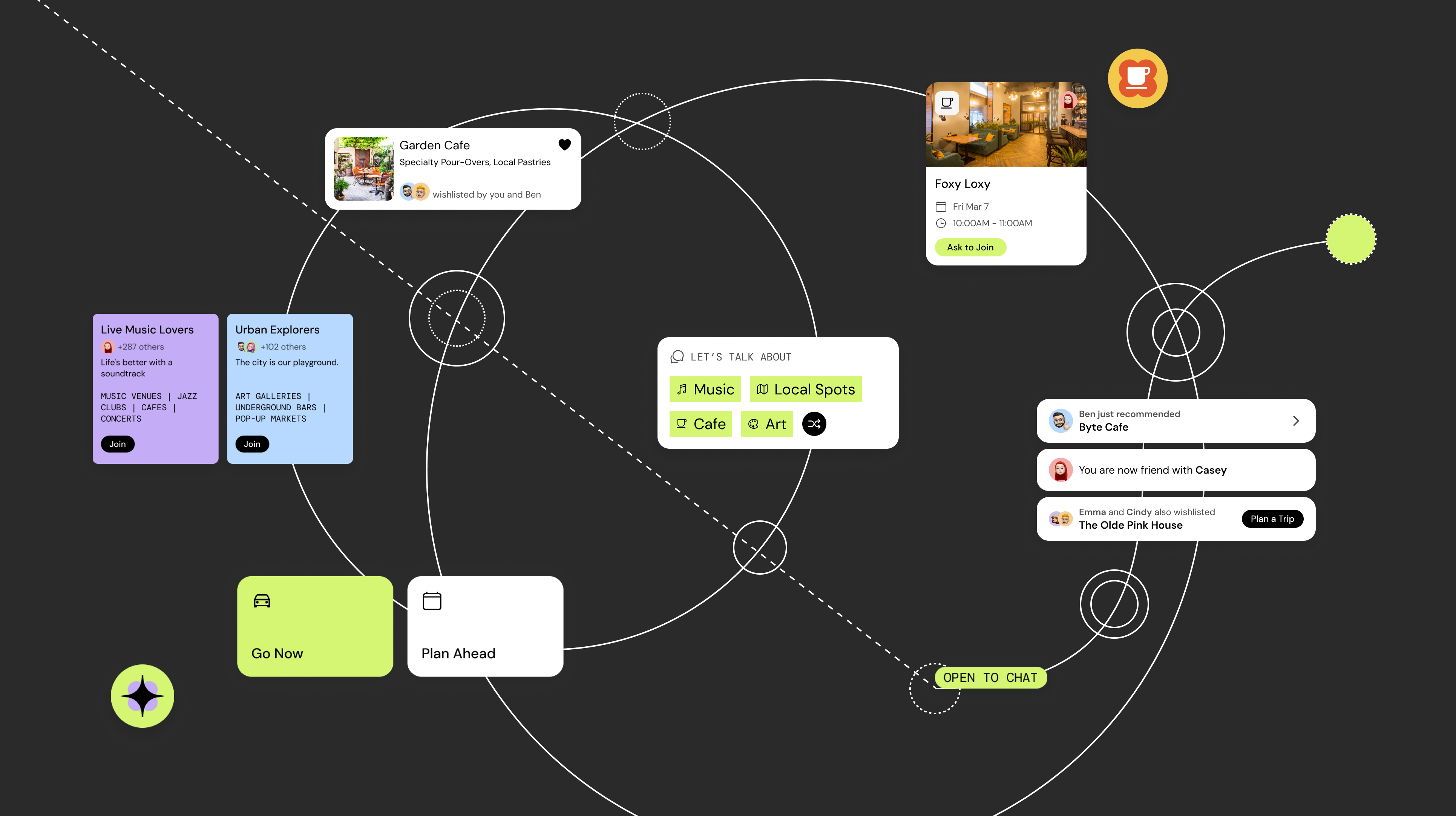
CoMove is a robotaxi ride-share ecosystem that uses context-aware matching and subtle facilitation to make shared rides feel socially readable, emotionally calm, and optionally connective.


System pillars

  1. Context-aware matchingPairs riders by interest compatibility + comfort levels, not just route efficiency.
  2. Adaptive social controlsUsers set ride-by-ride intent: “Open to chat” ↔ “Quiet mode,” with adjustable boundaries.
  3. Subtle in-ride facilitationShared cues, activities, and ambient controls reduce friction without forcing interaction.
  4. Community + destination discoveryCircles and place-based recommendations turn rides into ongoing local discovery and belonging.
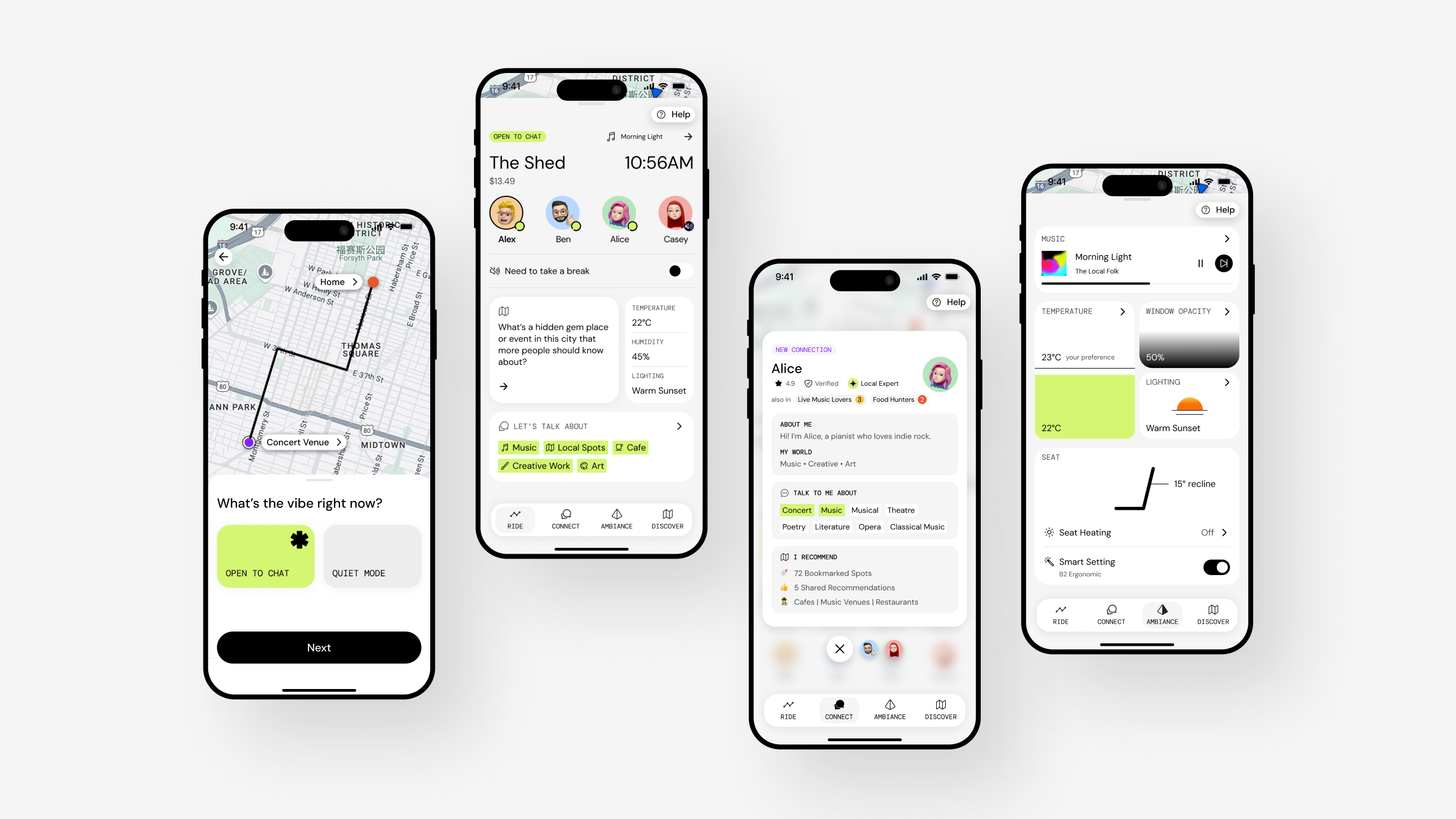
End-to-end experience design

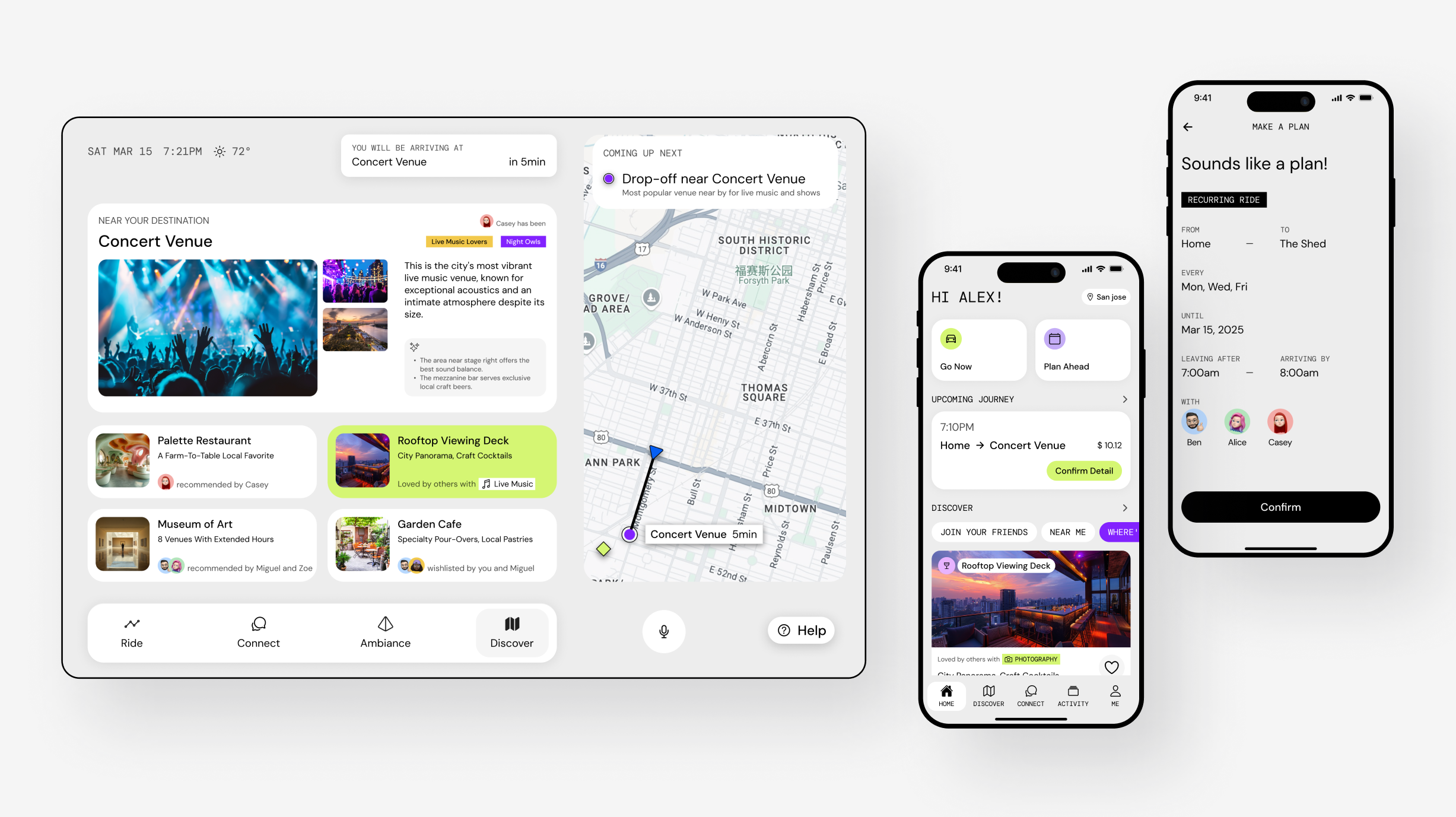
Instead of treating CoMove as a single app flow, I designed it across the full lifecycle—because connection doesn’t begin at boarding and end at drop-off.

Onboarding: defining boundaries and identity

Onboarding captures:

  • interests and expertise
  • conversation style
  • social intent by context
  • comfort boundaries and safety preferences


This data doesn’t exist “for personalization.” It exists to make social interaction legible and consent-based.
End-to-end experience design

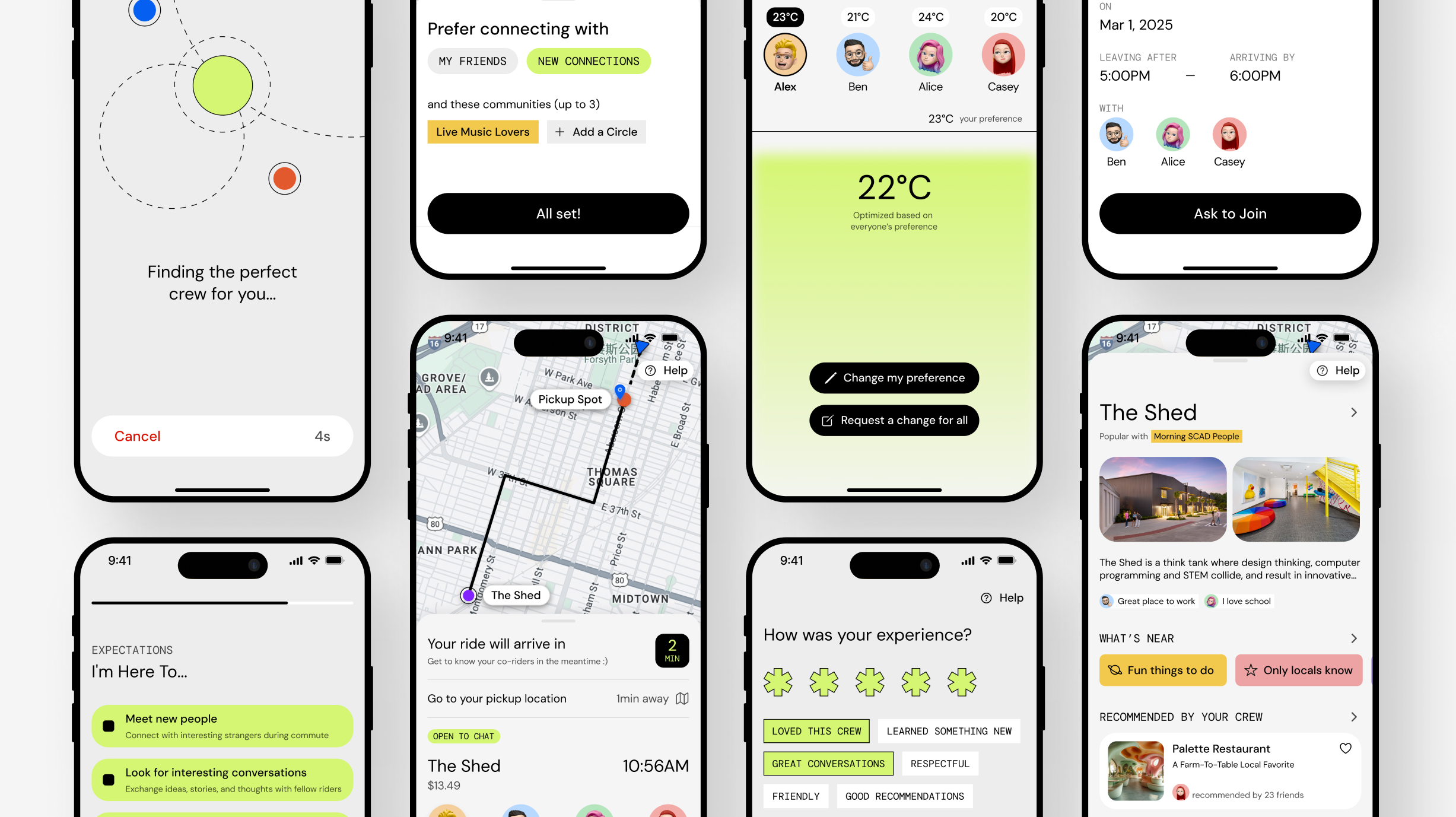
Booking: interaction as a choice

The booking UI supports:

  • commute patterns (recurring routes)
  • scheduled rides (planning and coordination)
  • on-demand rides (instant matching)

Before confirming, users can:

  • choose social mode
  • set matching preference (friends first / new connections / “circle match”)
  • invite friends or wait for responses

The goal: the user doesn’t “end up” in a social situation—they author it.

Pre-ride: lowering awkwardness

Before meeting, the system provides:

  • who you’ll ride with (shared interests, shared circles)
  • lightweight conversation scaffolds
  • destination context (events, landmarks, co-rider recommendations)


These cues reduce the anxiety of “what do we talk about” without scripting behavior.
End-to-end experience design

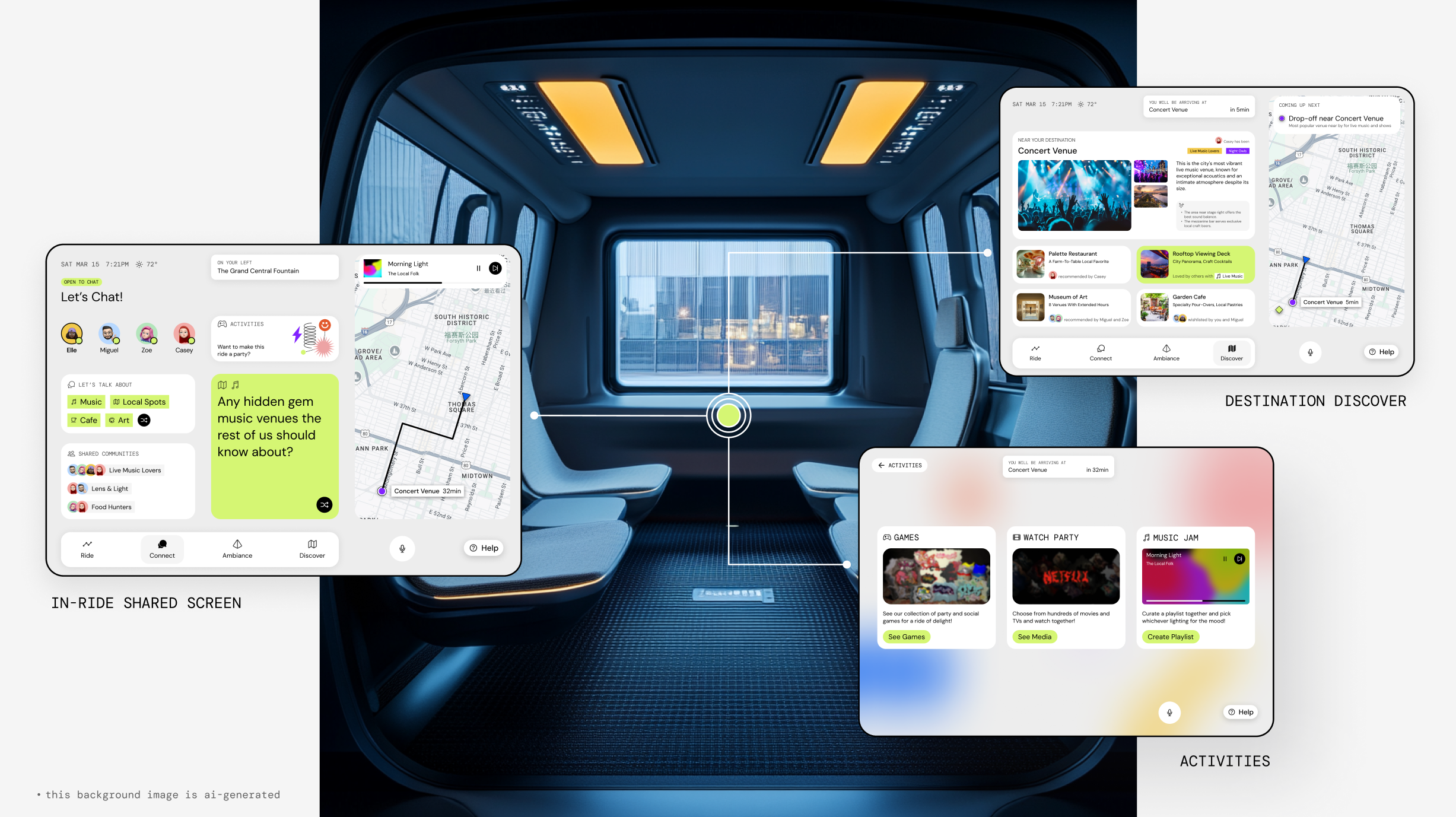
In-ride: facilitation without interruption

Inside the vehicle, shared surfaces show:

  • common ground and shared circles
  • optional topic suggestions aligned with group dynamics
  • location-based insights and co-rider recs
  • optional shared activities (games, music jam, watch party for longer rides)


Riders can:

  • shift topics
  • request ambience changes
  • bookmark places—all without direct social negotiation.
End-to-end experience design

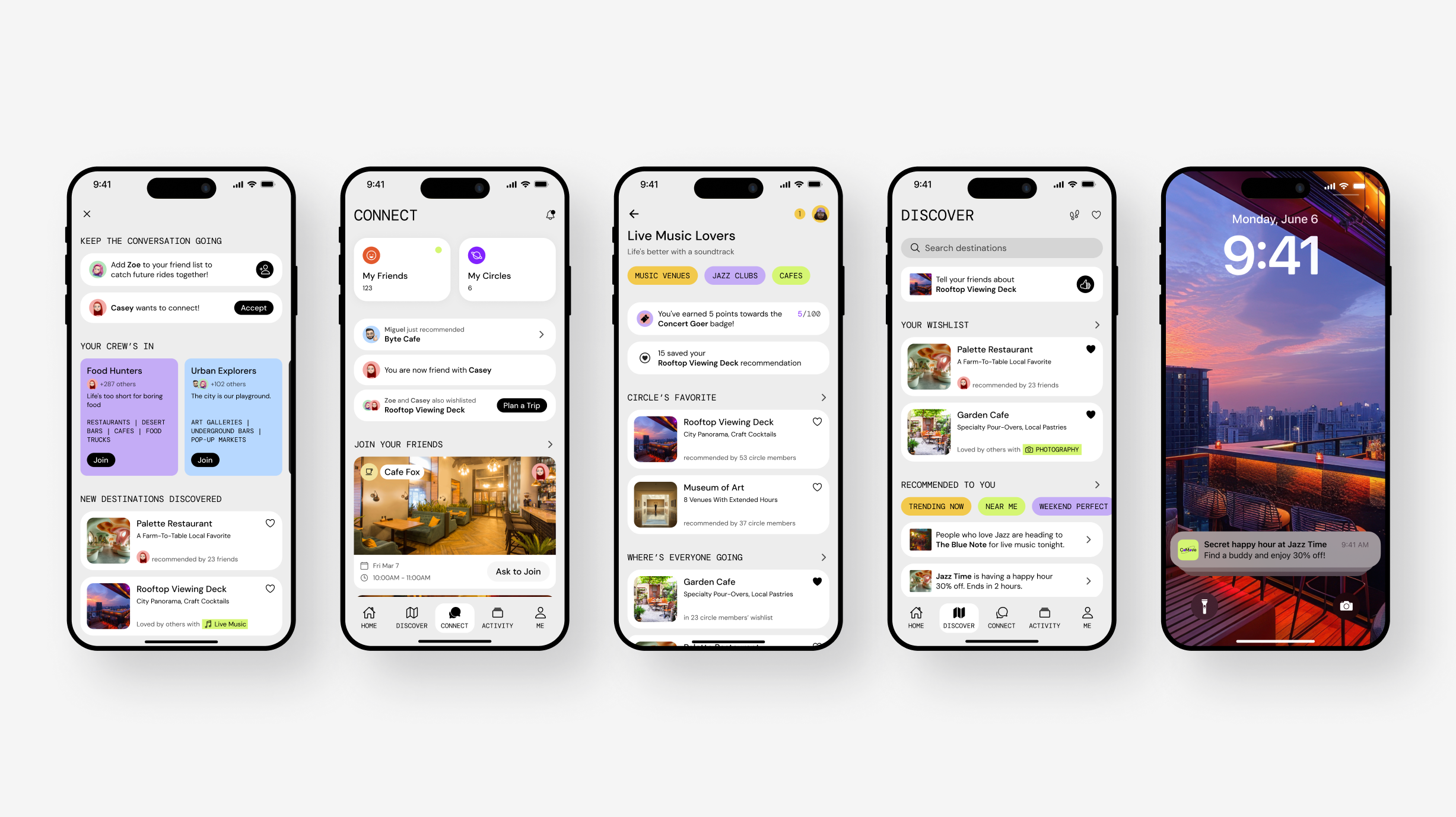
Post-ride: turning a moment into a thread

After the ride, users can:

  • add co-riders / join circles
  • wishlist discovered destinations
  • leave feedback and safety reports


The system learns and the user keeps what mattered.
Visual identity and brand system
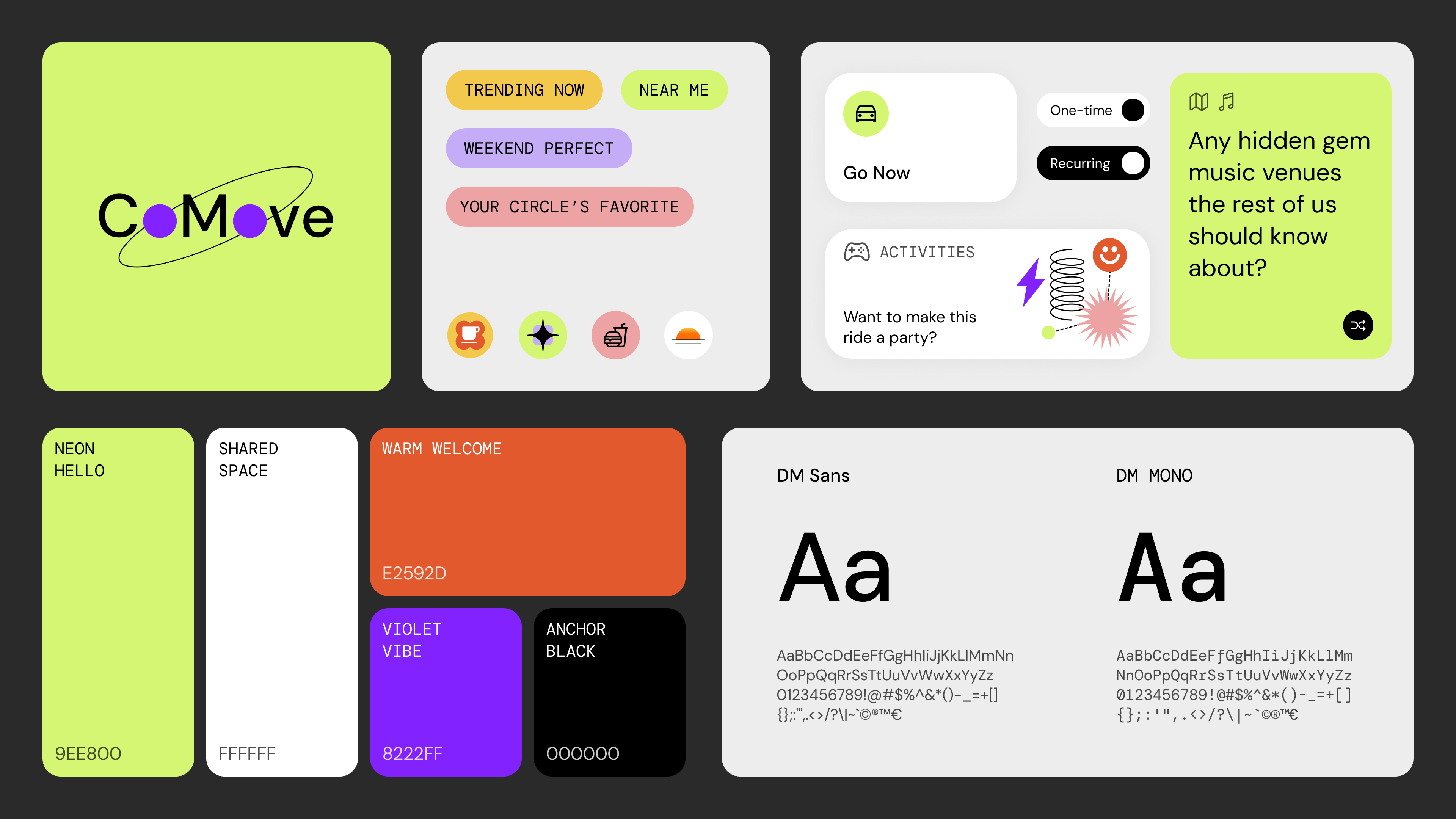
Brand personality:

“a connected host”

CoMove required a visual language that could do two jobs at once:

  1. feel safe and calm (so users trust it in a high-stakes environment)
  2. feel social and alive (so connection feels possible, not awkward)


Design approach:

  • Clean, readable layouts to reduce cognitive load in a shared environment
  • A modular icon system to communicate social intent quickly and politely
  • Visual hierarchy that privileges boundaries (modes, consent, controls)
  • A brand tone that feels modern and human—social without being performative


Rather than “branding then UX,” the identity was designed as part of the interaction system: the interface itself teaches the social norms.

When the idea meets reality

I think this is really innovative, making mobility a social platform. 


---- Student, 24, Princeton

Even an introvert like me want to try this out if it exists.


---- Student, 22, Savannah

I think this could be really popular among younger generations; it offers good incentives for people to keep using it.


---- UX Designer, 25, Atlanta

This could be the social media

of the new era!


---- Student, 21, Savannah

I’m excited to see this live.


---- Urban Designer, 24, Paris

This is another way to reimagine commute.


---- Student, 24, New Brunswick

How I validated

comfort, clarity, and desirability

I tested the concept and prototype with Gen Z participants (ages 19–25) across multiple regions using scenario-based evaluation, collecting qualitative feedback alongside usability metrics.


Results

  • SUS: 83.44 (excellent)
  • NPS: 75 (excellent)


Participants responded strongly to the low-pressure tone, the sense of safety created by matching, and the way digital facilitation supported physical conversation without replacing it.

International recognition

The project has been recognized by:

  • Red Dot Award — Brand & Communication Design
  • Good Design Award
  • C2A Creative Communication Awards — Best of Best
  • German Design Award — Distinction
  • MUSE Design Awards — Gold
  • London Design Awards — Silver (2×)
  • French Design Awards — Silver
  • New York Design Awards — Silver
  • International Design Awards — Bronze

What this project taught me

—and what it signals about how I design

CoMove changed how I approach product design: meaningful experiences often come from designing conditions, not adding features.


Key takeaways

  • Atmosphere is a product variable. Tone and hierarchy shape behavior as much as functionality.
  • Social design is boundary design. Control and consent are what make connection possible.
  • Systems beat screens. The strongest work lives across touchpoints, not in any single UI.
  • Brand and UX are inseparable. Visual language isn’t decoration, it’s also how the system communicates trust.


Ultimately, CoMove is a study in designing at the intersection of product systems, behavior, and visual language. It shows how research can translate into an ecosystem that feels calm, coherent, and alive.

CoMove

CoMove redefines ride-sharing for Gen Z by integrating AI-driven social matching to transform shared mobility into a platform for organic, interest-based interactions.

For

MFA Thesis

Time

Jan - Mar 2025

Role

Brand Design / UI design / UX design / UX Research

Type

Speculative / Mobility / Social / Mobile

The problem isn’t transit. It’s social comfort.

Mobility as a missed

social opportunity

Gen Z’s relationship with transportation is shifting in ways that traditional mobility products haven’t fully caught up with. They’re driving less, more sustainability-minded, and economically cautious, which makes shared mobility and public transit more relevant than ever. At the same time, they’re also seeking meaningful in-person connection, even as digital natives.


But today’s options often force a tradeoff:

  • Public transit can feel unsafe, uncomfortable, or socially awkward
  • Private vehicles offer comfort and control, but are expensive and increasingly misaligned with Gen Z priorities
  • Ride-sharing solves logistics, but rarely designs for the social experience of sharing space


This creates a gap: shared mobility is practical, but it doesn’t always feel socially or emotionally hospitable.


So CoMove reframes the question from “how do we move people efficiently?” to:


How might we bridge affordable shared mobility with the comfort and agency of private vehicles—by turning shared transit into an opportunity for organic connections?

Research into a design direction

I approached CoMove as both a mobility systems problem and a social behavior problem, using two complementary research tracks:

Track 1: Understanding the modern mobility landscape

I studied how Gen Z’s mobility preferences are evolving and how future urban mobility may shift across political, economic, social, technological, and legal dimensions—then explored where experience design could compensate for declining ownership with better shared experiences.


Methods included:

  • Literature review (32 sources)
  • PESTEL analysis (100+ sources)
  • Survey (n=216)
  • Expert consultation (n=11)
  • User interviews (n=28)
  • Synthesis across 1300+ data points


Key insights:

  • Gen Z values the journey as much as the destination
  • Sustainability matters, but economic pessimism shapes choices
  • A major reason to take transit is to socialize, not just to commute
  • Safety and affordability drive people away from car ownership
  • Community is “modular”: belonging shifts by context and interest
  • Digital natives still want in-person connection

Track 2: Focused research on Gen Z social preferences in transit

To translate trends into concrete product decisions, I studied how Gen Z forms new connections, what kinds of social moments feel natural, and what boundaries they need in shared spaces.


Methods included:

  • Industry expert interviews (n=4)
  • Gen Z user interviews (n=5)
  • Mobility preference surveys (n=14)
  • Social preference surveys (n=15)


Key insights that directly shaped the system:

  • Social preference is a spectrum, and changes by context → users need adjustable modes
  • Shared interests and destinations are the quickest, safest conversation starters
  • Users prefer spontaneous interaction over “forced socialization”
  • People feel safer socializing in groups (with friends / friends-of-friends)
  • Shared activities (e.g., games) make new connections easier
  • Users want control over their space, but hesitate to negotiate it directly
  • Safety is the non-negotiable foundation

What this meant for design

The research pointed to a consistent need: riders don’t want a “social app inside a car.” They want a shared experience that feels comfortable, optional, and socially readable, where the system quietly reduces awkwardness and protects boundaries.


This set the foundation for CoMove’s core principle:

Design structure that enables spontaneity by using matching, modes, and subtle cues to make connection possible without making it expected.

Building the Comove ecosystem

The product concept

CoMove is a robotaxi ride-share ecosystem that uses context-aware matching and subtle facilitation to make shared rides feel socially readable, emotionally calm, and optionally connective.


System pillars

  1. Context-aware matchingPairs riders by interest compatibility + comfort levels, not just route efficiency.
  2. Adaptive social controlsUsers set ride-by-ride intent: “Open to chat” ↔ “Quiet mode,” with adjustable boundaries.
  3. Subtle in-ride facilitationShared cues, activities, and ambient controls reduce friction without forcing interaction.
  4. Community + destination discoveryCircles and place-based recommendations turn rides into ongoing local discovery and belonging.

End-to-end experience design

Instead of treating CoMove as a single app flow, I designed it across the full lifecycle—because connection doesn’t begin at boarding and end at drop-off.

Onboarding: defining boundaries and identity

Onboarding captures:

  • interests and expertise
  • conversation style
  • social intent by context
  • comfort boundaries and safety preferences


This data doesn’t exist “for personalization.” It exists to make social interaction legible and consent-based.

End-to-end experience design

Booking: interaction as a choice

The booking UI supports:

  • commute patterns (recurring routes)
  • scheduled rides (planning and coordination)
  • on-demand rides (instant matching)

Before confirming, users can:

  • choose social mode
  • set matching preference (friends first / new connections / “circle match”)
  • invite friends or wait for responses

The goal: the user doesn’t “end up” in a social situation—they author it.

Pre-ride: lowering awkwardness

Before meeting, the system provides:

  • who you’ll ride with (shared interests, shared circles)
  • lightweight conversation scaffolds
  • destination context (events, landmarks, co-rider recommendations)


These cues reduce the anxiety of “what do we talk about” without scripting behavior.

End-to-end experience design

In-ride: facilitation without interruption

Inside the vehicle, shared surfaces show:

  • common ground and shared circles
  • optional topic suggestions aligned with group dynamics
  • location-based insights and co-rider recs
  • optional shared activities (games, music jam, watch party for longer rides)


Riders can:

  • shift topics
  • request ambience changes
  • bookmark places—all without direct social negotiation.

End-to-end experience design

Post-ride: turning a moment into a thread

After the ride, users can:

  • add co-riders / join circles
  • wishlist discovered destinations
  • leave feedback and safety reports


The system learns and the user keeps what mattered.

Visual identity and brand system

Brand personality:

“a connected host”

CoMove required a visual language that could do two jobs at once:

  1. feel safe and calm (so users trust it in a high-stakes environment)
  2. feel social and alive (so connection feels possible, not awkward)


Design approach:

  • Clean, readable layouts to reduce cognitive load in a shared environment
  • A modular icon system to communicate social intent quickly and politely
  • Visual hierarchy that privileges boundaries (modes, consent, controls)
  • A brand tone that feels modern and human—social without being performative


Rather than “branding then UX,” the identity was designed as part of the interaction system: the interface itself teaches the social norms.

When the idea meets reality

I think this is really innovative, making mobility a social platform. 


---- Student, 24, Princeton

Even an introvert like me want to try this out if it exists.


---- Student, 22, Savannah

I think this could be really popular among younger generations; it offers good incentives for people to keep using it.


---- UX Designer, 25, Atlanta

This could be the social media

of the new era!


---- Student, 21, Savannah

I’m excited to see this live.


---- Urban Designer, 24, Paris

This is another way to reimagine commute.


---- Student, 24, New Brunswick

How I validated

comfort, clarity, and desirability

I tested the concept and prototype with Gen Z participants (ages 19–25) across multiple regions using scenario-based evaluation, collecting qualitative feedback alongside usability metrics.


Results

  • SUS: 83.44 (excellent)
  • NPS: 75 (excellent)


Participants responded strongly to the low-pressure tone, the sense of safety created by matching, and the way digital facilitation supported physical conversation without replacing it.

International recognition

The project has been recognized by:

  • Red Dot Award — Brand & Communication Design
  • Good Design Award
  • C2A Creative Communication Awards — Best of Best
  • German Design Award — Distinction
  • MUSE Design Awards — Gold
  • London Design Awards — Silver (2×)
  • French Design Awards — Silver
  • New York Design Awards — Silver
  • International Design Awards — Bronze

What this project taught me

—and what it signals about how I design

CoMove changed how I approach product design: meaningful experiences often come from designing conditions, not adding features.


Key takeaways

  • Atmosphere is a product variable. Tone and hierarchy shape behavior as much as functionality.
  • Social design is boundary design. Control and consent are what make connection possible.
  • Systems beat screens. The strongest work lives across touchpoints, not in any single UI.
  • Brand and UX are inseparable. Visual language isn’t decoration, it’s also how the system communicates trust.


Ultimately, CoMove is a study in designing at the intersection of product systems, behavior, and visual language. It shows how research can translate into an ecosystem that feels calm, coherent, and alive.